

A camera is basically a light tight box, and in order to expose an image, there must be a way of letting in a controlled amount of light.
An aperture is simply a hole that lets in light.

Adjusting the size of the aperture controls the amount of light that enters the camera during exposure.
The size of the aperture opening is measured in f-stops.
Starting with f/1.0 we have a series of numbers that represent full stops.
These full f-stops, from larger to smaller, are as follows:
f/: 1.0, 1.4, 2.0, 2.8, 4.0, 5.6, 8, 11, 16, 22, 32, 45, etc.
It is often confusing at first to get used to the larger numbers representing a smaller opening. In the illustrations below you can see how the size of the aperture gets smaller as the number of the f-stop gets larger.
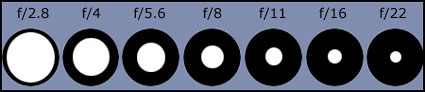
Each full f-stop lets in exactly 1/2 the amount of light as the previous stop, and twice the amount as the next stop. So f/5.6 lets in 1/2 as much light as f/4, and twice as much as f/8.
Shutter speeds are also set up this way as will be explained in the camera shutter speeds lecture.
In addition to controlling exposure, f-stops also affect depth of field. The smaller the f-stop you use, the more depth of field you get. For more on Depth of Field click HERE.


[…] Apertures and f-Stops : An aperture is a hole that lets a controlled amount of light reach the camera’s image sensor during exposure. The aperture size is measured in f-stops. […]
[…] of light that is used to expose the camera’s image sensor. It does this by adjusting the aperture and the shutter […]