Nikon 1 J1 Review

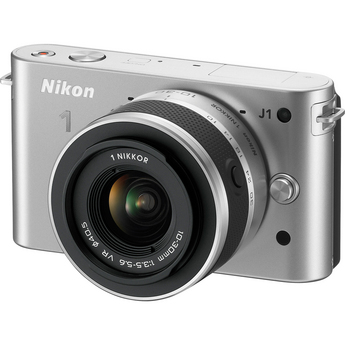
Nikon 1 J1

The Nikon 1 J1 is Nikon’s introductory level mirrorless camera. The J1 is a compact, light weight point and shoot with interchangeable lenses, full 1080p HD video, and a whole lot more …

Nikon has finally introduced its much awaited line of mirrorless cameras … compact digital cameras with interchangeable lenses. The Nikon 1 series includes the more upscale model V1 and this introductory level model the J1.
Here’s a few highlights from Nikon’s description on Amazon:

Revolutionary new Nikon 1 system breaks visual barriers

Nikon 1 J1

Nikon 1 J1 Black

For your very mobile lifestyle comes a completely new imaging system with freedom to create and express as never before. Highly compact and portable, the Nikon 1 J1 goes everywhere you go. Moments from your amazing world are captured using a highly responsive autofocus and super fast shooting speed. In one touch you can work in Full HD (1080p) movie record mode. A camera so versatile you can even snap photos while recording movies. Unleash your creativity with Nikon 1—offering a balance of high performance, advanced features, portability and a newly designed interchangeable lens system. Infuse your world with photos from every moment and connect as never before.

Innovation in technology and design

Today, all it takes is a single imaging device to capture and share every moment of an incredible and connected life. Nikon brings an evolution in imaging technology, starting with a newly developed Nikon CX-format super high-speed AF CMOS sensor that powers every capture. Ensure image precision through the new, compact interchangeable lens system featuring image stabilization (VR) and superior fast and quiet autofocus motors built on the NIKKOR heritage of optical excellence.

Nikon also boasts that the J1 auto focus is “as fast as you are” with an impressive 10 fps speed in auto focus mode.

This compact little camera features full HD video at 1080p and it also allows you to snap a still photo while recording your video.

More from Nikon:

Nikkor lenses for the J1

Quality Nikkor Lenses

Compact, light, high performance optics

Expand creativity and select from a range of lens options, including one designed specifically for movie filming. Engineered for fast and easy swap-out, stay photo-ready all the time.

Compactness brings portability, whether using the single focal length 10mm or the 30-110mm telephoto. 1 NIKKOR lenses feature vibration reduction (VR) to keep photos sharp, extending a heritage of precision symbolized by durability, superior image quality and optical excellence.
Read more on Amazon:  Nikon 1 J1 10.1 MP HD Digital Camera System with 10-30mm VR 1 NIKKOR Lens

The folks over at Digital Camera Review.com had some good and some not so good thoughts in their review of  the Nikon J1 …

Review Summary:

The Nikon 1 J1 is a good camera in a lot of ways. Great image and video quality and some solid optics make it easy to give it a favorable review, but it’s not a must-have for enthusiasts and Nikon fans.

Pros

  • Good still image quality
  • Excellent video quality
  • Good AF performance

Cons

  • Very pricey
  • No viewfinder
  • Battery life less than stellar

The J1 is the entry-level camera while the V1 contains a few extra features such as electronic viewfinder (EVF), higher dot composition LCD monitor and an i-TTL sensor that can accommodate an optional external flash unit.

Outwardly, the cameras appear very similar with the V1 being differentiated by a hump on the top of the body housing the EVF and a small ridge on the right front to afford a better grip. Internally, the image capture hardware is identical: a 10.1 megapixel resolution CMOS sensor measuring 13.2 x 8.8mm, designated as “CX” in Nikon terminology and providing a 2.7x crop factor. Nikon’s new EXPEED 3 image processing engine drives the system and reportedly provides rapid response, fast AF and high-speed performance. In addition, the new dual core EXPEED 3 processor works to maximize battery >efficiency while providing high-speed processing and faster transfer rates.

Both cameras feature a new AF system that, according to Nikon, provides “…incredibly fast, split-second response.” Nikon goes on to describe it as a “…newly developed hybrid system that continuously evaluates the scene at hand for optimal results, and can switch between phase detection and contrast detect AF to best suit the scene.” Nikon claims this new system is the “world’s fastest autofocus,” albeit under a set of conditions that we will discuss later.

The nominal continuous high-speed shooting rate is 5 frames per second (fps) at full resolution, but the electronic shutter offers 10, 30, or 60 fps rates at full resolution as well. The camera can capture still images in JPEG, NEF (RAW) or NEF/JPEG combinations. Full HD video can be captured at 30 or 60 fps, and there are rates of 400 and 1200 fps for slow motion work. ISO ranges from 100 to 3200, with a 6400 setting available.
You can read the Full Review at Digital Camera Review.com

You can also watch a video review of the J1 on the Videos page

If you’re looking for an introductory model camera in the  mirrorless interchangeable lenses category, and you are a fan of Nikon cameras, then the Nikon 1 J1 is worth looking at. It’s full HD video capacity along with being able to shoot stills while video recording could make this a good choice for those folks who like shooting their kids’ soccer games … or any other similar sporting events that happen so fast you can easily miss the best shots.

Again, remember to check out our Series of Tips for Buying Digital Cameras for some good ways to narrow your choices to make sure you get the right camera for your kind of photography.

Here’s to better photography …

Al Hannigan

Al Hannigan

Canon PowerShot ELPH 300HS Review


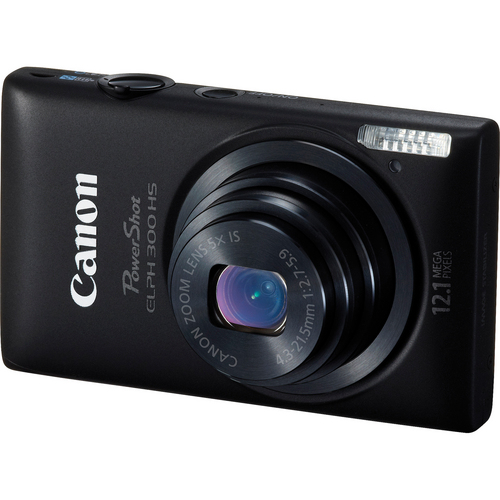
Canon PowerShot ELPH 300HS

The PowerShot ELPH 300 HS digital camera boasts a slim profile as well as good looks. And appearance isn’t the only thing this slick little device offers  …  it will also deliver brilliant still images, ultra-detailed 1080p Full HD video, serious functionality, and a wealth of effects and automatic settings.

You might be surprised when you learn just how much is packed into such a slim point-and-shoot. Let your imagination run wild, and let Canon’s HS SYSTEM, a 24mm lens, 5x Optical Zoom, and 12.1 Megapixels help you snap great photos everywhere.

Some of the Technical Details

Color: Black
  • World’s thinnest digital camera with a 24mm ultra Wide-Angle lens and 5x Optical Zoom and Optical Image Stabilizer
  • Canon’s HS SYSTEM with a 12.1 MP CMOS and DIGIC 4 Image Processor improves shooting in low-light situations without the need for a flash
  • Full 1080p HD Video for exceptional quality with stereo sound, plus a dedicated movie button for easy access
  • Get high-speed shooting in a point-and-shoot camera: High-speed Burst Mode captures 8.0fps and
  • Smart AUTO intelligently selects the proper settings for the camera based on 32 predefined shooting situations
  • And lowers noise levels at higher ISO settings
  • World’s thinnest digital camera with a 24mm ultra Wide-Angle lens and 5x Optical Zoom and Optical Image Stabilizer.
  • Full 1080p HD Video for exceptional quality with stereo sound, plus a dedicated movie button for easy access.
  • Smart AUTO intelligently selects the proper settings for the camera based on 32 predefined shooting situations.
  • Super Slow Motion Movie records video at high speeds to allow slow motion playback.
  • Zoom optically while shooting video and keep footage stabilized with Dynamic IS.
  • And lowers noise levels at higher ISO settings.

Incredibly Thin. Incredibly Powerful.

Thin Is In
Canon PowerShot ELPH 300 HSThe ELPH 300 HS is less than an inch deep and weighs less than 5 ounces.

At less than an inch deep and weighing just under five ounces, the PowerShot 300 HS will fit right in your pocket, but it packs plenty of power into its sleek point-and-shoot body. A 24mm ultra wide-angle lens with a powerful 5x optical zoom gives you the versatility to shoot in any number of situations, and the optical image stabilizer keeps things from getting too shaky when you’re zoomed in tight. Whether you’re out partying or just walking around town, you don’t need to sacrifice style for power–the PowerShot ELPH 300 HS has got you covered for capturing great photos effortlessly.

Read More at Amazon.com

Here are some of the highlights from the ELPH 300HS review at Digital Camera Review …

The PowerShot 300 HS delivers good images and reliable performance in a variety of shooting conditions.

Pros

  • Excellent ergonomics
  • Instant startup
  • High quality video

Cons

  • Poorly attached port cover
  • Flash inconveniently located
  • Occasional overexposure

Canon PowerShot 300 HS (previously #1) – It may not reign supreme on our top ten list any longer, but the 300 HS is just as capable as ever. It continues to offer 1080 HD video recording, a 12.1 megapixel CMOS sensor and DIGIC 4 processor. Canon PowerShot 300 HS Review | Canon PowerShot 300 HS User Opinions

Canon PowerShot ELPH 300 HS Full Review

The Canon Powershot ELPH 300 HS (IXUS 220 HS) is one of several new compact digital cameras recently released by Canon with a new naming convention – “Powershot ELPH xxx HS” rather than “Powershot SDxxx IS.” The ELPH 300 HS is the newest model of the line of compact cameras whose previous version was the SD1400 IS, a fine camera that I reviewed for this website (the earlier versions of the camera, the SD940 IS and SD780 IS, were also reviewed by this website). However, the ELPH 300 HS improves upon the SD1400 IS in several significant ways.

Most importantly, it has a different sensor, a 12.1 megapixel CMOS sensor compared to the 14.1 megapixel CCD sensor of the earlier version. The new sensor is designed to give the camera enhanced low light image quality and faster speed. The new camera also has a lens with a wider angle of view, 24mm compared to 28mm, and more optical zoom, 5x compared to 4x.

The ELPH 300 HS has a higher quality video mode, 1920 x 1080 resolution (full HD) at 24 frames per second, compared to 1280 x 720 (30 fps). It uses Canon’s latest processor, the DIGIC 4. It also has several features that are absent in the older cameras, including a Super Slow Motion video mode, which can record video at up to 240 fps. With all these improvements I was eager to try out Canon’s new camera.

You can read the full review here: Digital Camera Review.com


How do you decide if this, or any of the many other digital cameras we evaluate here, is a good choice for you?  Certainly reviews  can help, but choosing the right camera always boils down to your own personal approach to photography.

While it may seem nice to have lots of features and all the bells and whistles that many digital cameras offer, they are only valuable if they help you do the kind of photography that you are most interested in doing.

To help you with this, you may find these Camera Buying Tips helpful.

You can also see a video review on the Videos page

And let us know your own thoughts on this camera in the comments section, especially if you own or have used this camera.

Here’s to better photography …

Al Hannigan

Al Hannigan

Digital Camera Image Sensor

An image sensor is the digital equivalent to film in a conventional camera.

Unlike film, however, the image sensor is built into the digital camera and cannot be changed for different situations.

The most common sensors used today in digital cameras are the CCD (Charged Couple Device) and the CMOS (Complementary Metal Oxide Semiconductor).

If you want to know which kind your camera has, go to the specifications page in the owner’s manual.

The full details on how image sensors work is beyond the scope of this lecture series, but a few things that do affect your images are important, and that is what we’ll be covering here.

Complex Technology…What’s a Pixel

Image Pixels

Example of image area enlarged 1600 % to show pixels

Images created with a digital camera are made up of pixels, which are small squares of color ( or shades of gray in the case of a B&W image ). The camera’s image sensor must convert the light it is exposed to into these pixels to render an image.

Image sensors are comprised of millions of tiny photo sensors (pixels) that record the intensity of light as an electrical charge. It then converts this charge into digital information that is used to create the final image.

The data must go through various stages of interpretation and conversion, but for most practical applications it isn’t necessary to understand all the specific details.

It is important, however, to recognize that image quality can be affected by this technology, and some cameras do a better job than others.

Sensor Sizes in Digital Cameras

One factor to consider is sensor size. In most digital compacts, image sensors cover only about 4% to 7% of the image area of 35mm film. Digital SLR image sensors will generally cover from 33% to a very few that cover 100% of the 35mm film area.

Since larger sensors have larger pixels, they can record more detail and produce smoother images. Generally, larger sensors capture images with less noise and greater dynamic range than smaller sensors.

When choosing a digital camera therefore, it is important to consider the actual size of the sensor as well as how many mega pixels the camera has. A 5 megapixel digital compact camera will not necessarily have the same quality as a 5 megapixel DSLR (digital single lens reflex).

The sensor size has what is referred to as a crop factor, or a focal length multiplier. This is a number that relates the smaller sensors to a full frame 35mm area. It is one of the reasons that a full frame 12 Mega Pixel DSLR will usually create a higher quality image than a 12 MP camera that does not have a full frame sensor.

NOTE: Don’t confuse larger ‘sensor pixels’ with larger ‘image pixels’. A larger sensor pixel can collect more detail, and produce finer images. This is good. Large pixels in the photo image mean less quality and can cause pixelation…this is when you begin to see the pixels in your image. This is not good.

To use an analogy, say you have 5 million blocks and they need to fit into a .25 inch x .375 inch area (size of a typical compact digital camera image sensor). The blocks would need to be small enough for all 5 million to fit.

Now let’s say you have a 1 inch x 1.5 inch area (approximate size of 35mm film) to fit the same number of blocks into. Having more area to work with would therefore allow each block to be made larger.

The same idea holds true for sensor pixels. To fit 5 million pixels into a smaller sensor, each pixel must be reduced or compressed. This compression can reduce the amount of data each pixel can gather. This is why pixel count should be only one of several factors you compare when considering image quality.

It would be important to understand this technology for anyone doing a serious review of various digital cameras. But for most photographers it is something you need to be aware of, if only to realize that pixel count alone is not enough to assure you of high quality images. Comparing final image results is the best way to judge a camera’s performance.

Image Sensors Exposed

When you take a picture, you are exposing the image sensor to light. The data collected by the sensor’s pixels are recorded, analyzed and processed to yield a digital image that looks similar to the scene you photographed.

This complex operation is another factor which affects final image quality, and varies from one camera to another. Such matters as noise, color accuracy, sharpness and tonal range, to mention but a few, are all affected by this process.

So again, the importance to you as a photographer is best seen by comparing final results. Fortunately, there are some excellent review sites that do this for you. Therefore, you don’t need to actually test every camera yourself. But knowing a little about sensors and pixels will help you better understand these reviews.

Whenever you want to compare cameras you are considering, or learn more specifics about a camera you already own, just do a search for digital camera reviews on any major search engine to find a list of these review type sites.

You’ll locate some excellent sites that do extensive in-depth comparisons of most of the popular cameras available. They will usually have samples of actual photos taken with these cameras as well, so you’ll be able to see the level of quality each can produce.

Three of my favorites are:

dpreview.com
Steve’s Digicams
Imaging Resource

There are many others for you to choose from, but these are 3 I have used myself and am most familiar with.

Here’s to better photography …

Al Hannigan

Al Hannigan

Camera Shutter Speeds

In this photography lecture we’ll discuss camera shutter speeds. The shutter speed is one of the controls that determines the exact amount of exposure your film or image sensor receives.

Shutter speed controls the time of an exposure by controlling exactly how long the aperture remains open. The shutter speed also has other effects on your pictures which will be covered as well.

The following is a list of the full shutter speeds, starting with 1 second:

1, 1/2, 1/4, 1/8, 1/15, 1/30, 1/60, 1/125, 1/250, 1/500, 1/1000, etc.

Each of the above shutter speeds is 1/2 the amount of time as the previous speed.
Read more »